Featured Robotics & Smart Hardware Catalog
Explore high-performance autonomous hardware, companion robotics, and optical components distributed across the Osaka import-export network.

The Technical Reality of Sony Aibo Lifespan in Commercial Sourcing
When enterprise purchasers, international buyers, and institutional procurers in the Osaka market evaluate the acquisition of autonomous companion robots—specifically the renowned Sony Aibo ERS-1000 series—the core question always converges on hardware operational lifespan, battery longevity, repairability, and long-term total cost of ownership (TCO). Osaka has historically functioned as the commercial engine of Kansai, serving as a pivotal node for high-tech distribution, commercial export hubs, and institutional care integration.
Understanding the actual Sony Aibo lifespan requires going beyond consumer marketing figures. Aibo is not merely an electronic toy; it is a highly sophisticated cybernetic system equipped with a 64-bit quad-core processing engine, 22 degrees of freedom (DOF) powered by custom micro-actuators, dual OLED visual array displays, SLAM (Simultaneous Localization and Mapping) optical cameras, capacitive touch sensors, and continuous cloud telemetry. For B2B importers, trading houses, and institutional care facility buyers in Osaka, quantifying component wear and establishing preventative maintenance frameworks is paramount to maximizing investment returns.
As premier suppliers and exporters operating at the intersection of Chinese robotics manufacturing and Japanese distribution networks, companies like Shenzhen Aiborobo Technology Co., Ltd. provide global trade partners with transparent engineering diagnostics, localized replacement parts, and direct component-level technical clarity that conventional consumer retailers fail to deliver.
Engineering Breakdown: Sony Aibo Subsystem Durability Metrics
To accurately project the depreciation and functional life of Aibo units deployed across Osaka commercial facilities, senior hardware engineers categorize component failure rates across four core sub-assemblies:
| Subsystem Hardware | Expected Operational Horizon | Primary Degradation Factor | Maintenance & Mitigation Strategy |
|---|---|---|---|
| 22-Axis Actuators | 3,500 to 5,000 Total Active Hours | Gearbox gear wear, micro-motor brush heat buildup | Joint torque calibration, thermal throttling, gear re-greasing |
| Lithium-Ion Battery Cell | 2.5 to 3.5 Years (approx. 800 cycles) | Electrolyte oxidation, capacity drop from frequent auto-docking | Cell-level battery pack replacement, charge cycle optimization |
| SLAM Visual & ToF Cameras | 60,000+ Continuous Hours | Lens surface scratches, dust accumulation on optical sensors | Protective optical casing cleanings, IR sensor recalibration |
| OLED Expression Eyes | 40,000 Visual Display Hours | Organic LED luminance burn-in, flex cable ribbon strain | Firmware auto-dimming when idle, flex connector inspections |
| Capacitive Skin Sensors | 500,000 Tactile Contacts | Surface friction wear, static discharge interference | Anti-static housing treatment, tactile pad replacement |
Mechanical stress is overwhelmingly concentrated in the knee, hip, and neck joints. The ERS-1000 uses proprietary gear trains designed for lifelike, fluid motion. However, continuous operation on abrasive floor surfaces—such as rough commercial carpets often found in trade venues—accelerates gear tooth shear. Osaka buyers are advised to deploy Aibo on polished timber, smooth laminate, or low-pile static-dissipative mats to preserve joint integrity.
Localized Application Scenarios in Osaka & Kansai Enterprise Hubs
The Osaka procurement landscape for companion robots differs significantly from western consumer markets. As Japan’s elder care infrastructure rapidly transforms and commercial space efficiency becomes a prime priority, Aibo and related AI companion robots fulfill distinct economic and operational roles:
Senior Care Facilities in Osaka Prefecture
Elderly care centers in Osaka urban districts (such as Chuo-ku, Kita-ku, and Sakai City) utilize companion robots for non-pharmacological therapy. Aibo reduces agitation in dementia patients without the sanitation, allergen, and liability issues associated with live animals.
Retail Experience Centers in Umeda & Namba
Osaka’s flagship electronics malls and luxury retail outlets integrate interactive robotic dogs into storefront displays to increase foot traffic dwelling time. Robotic agility serves as a magnet for tourists and tech enthusiasts alike.
Re-Export & Refurbishment Supply Chains
Osaka acts as a central shipping gateway via Kansai International Airport (KIX) and the Port of Osaka. Trading firms source pre-owned or surplus companion units, perform component refurbishments, and export reconditioned robotics globally.
Kansai Robotics Trends: The Shift Towards Hybrid Local-Cloud AI
The enterprise deployment of robotic dogs in Osaka is undergoing a major structural evolution. Initially, buyers relied entirely on proprietary cloud subscriptions tied directly to manufacturer servers. However, recent trends in the Kansai technology corridor highlight three pivotal shifts:
- Local Edge Offloading: To combat latency and ensure functionality during network disruptions, commercial operators in Japan are demanding hybrid robots that retain core facial recognition and gait control locally without mandatory cloud handshakes.
- Battery Refurbishment Ecosystems: Rather than discarding units when original battery packs degrade below 60% capacity, Osaka B2B repair facilities are adopting high-density replacement lithium cells engineered specifically for high-drain micro-actuators.
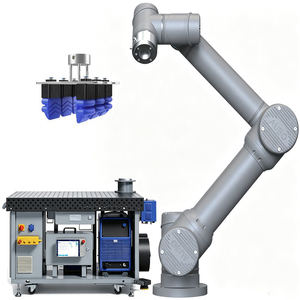
- Cross-Platform Companion Integration: Facility managers are combining companion dogs like Aibo with industrial collaborative arms (such as the AUBO C5 cobot series) and custom caretaking robots to build fully automated hybrid care and entertainment environments.
Why Osaka Traders & Global Buyers Partner with Shenzhen Aiborobo Technology Co., Ltd.
Navigating the secondary market, OEM manufacturing channels, and international export procedures for smart robotics requires a trusted partner with deep technical capability and supply chain mastery. Shenzhen Aiborobo Technology Co., Ltd. stands out as a premier partner for B2B clients in Osaka and worldwide:
Rigorous Engineering Quality Control
Every robotic dog and cobot system undergoes multi-point actuator stress testing, thermal imaging inspections, and battery cycle verification before packaging.
Comprehensive Spare Parts Availability
We maintain a direct inventory of replacement micro-servos, battery modules, optical lenses, and mainboards to guarantee long-term repairability and eliminate extended downtime.
Seamless Export Logistics
Our export compliance team manages UN38.3 battery shipping certifications, custom protective foam packaging, and express freight directly into Osaka ports and global destinations.
Frequently Asked Questions: Osaka B2B Robotics Procurement
What is the typical battery lifespan of a Sony Aibo during continuous daily use?
Under continuous commercial operation, a fully charged internal lithium-ion pack provides roughly 2 hours of active movement. The total cell lifespan covers approximately 800 full charge-discharge cycles (about 2.5 to 3 years of daily usage) before capacity drops below 80%. Battery replacements can easily restore full operational duration.
Can a Sony Aibo imported from Japan function smoothly in overseas cloud environments?
Yes, but region-specific network protocols must be verified. Japanese domestic models utilize embedded SIM/LTE chips tuned to NTT Docomo bands. For international re-export, Wi-Fi connectivity allows core AI functions, though registering regional cloud accounts requires verifying regional server compatibility with our technical team prior to bulk order dispatch.
What happens when Sony eventually discontinues official cloud server support for ERS-1000?
Even if remote cloud server services transition, Aibo retains offline autonomous behaviors—including spatial navigation via local SLAM, basic touch responsiveness, voice recognition algorithms, and pre-programmed trick execution. Furthermore, independent robotics developers continue to build localized edge software bypasses.
How do enterprise buyers in Osaka handle joint actuator wear and repair maintenance?
Institutional purchasers typically establish a maintenance reserve contract or partner with specialized suppliers like Shenzhen Aiborobo Technology Co., Ltd. to stock modular limb assemblies (ears, legs, tail gearboxes). Individual servo joints can be swapped out within 45 minutes by trained service personnel.
Are companion robots compliant with Japanese healthcare and eldercare safety regulations?
Yes. Robotic pets such as Aibo comply with standard low-voltage electrical safety protocols (PSE certification in Japan) and emit non-ionizing RF signals well within safe medical tolerance limits. Unlike living animals, they present zero biohazard risks, require no feeding, and can be sanitized using standard surface disinfectant wipes.
Why choose Shenzhen Aiborobo Technology Co., Ltd. over gray-market exporters in Osaka?
Gray-market vendors simply trade unverified used hardware without technical guarantees. Shenzhen Aiborobo Technology Co., Ltd. conducts rigorous hardware bench testing, offers warranty coverage, provides full component sourcing, and delivers professional engineering consultation for custom commercial deployments.
Ready to Upgrade Your Commercial Robotics Sourcing?
Whether you are establishing an eldercare companion program in Osaka, sourcing verified units for re-export, or seeking component-level engineering support, our expert team is ready to deliver tailored quotations and hardware diagnostics.
Get a Quote